
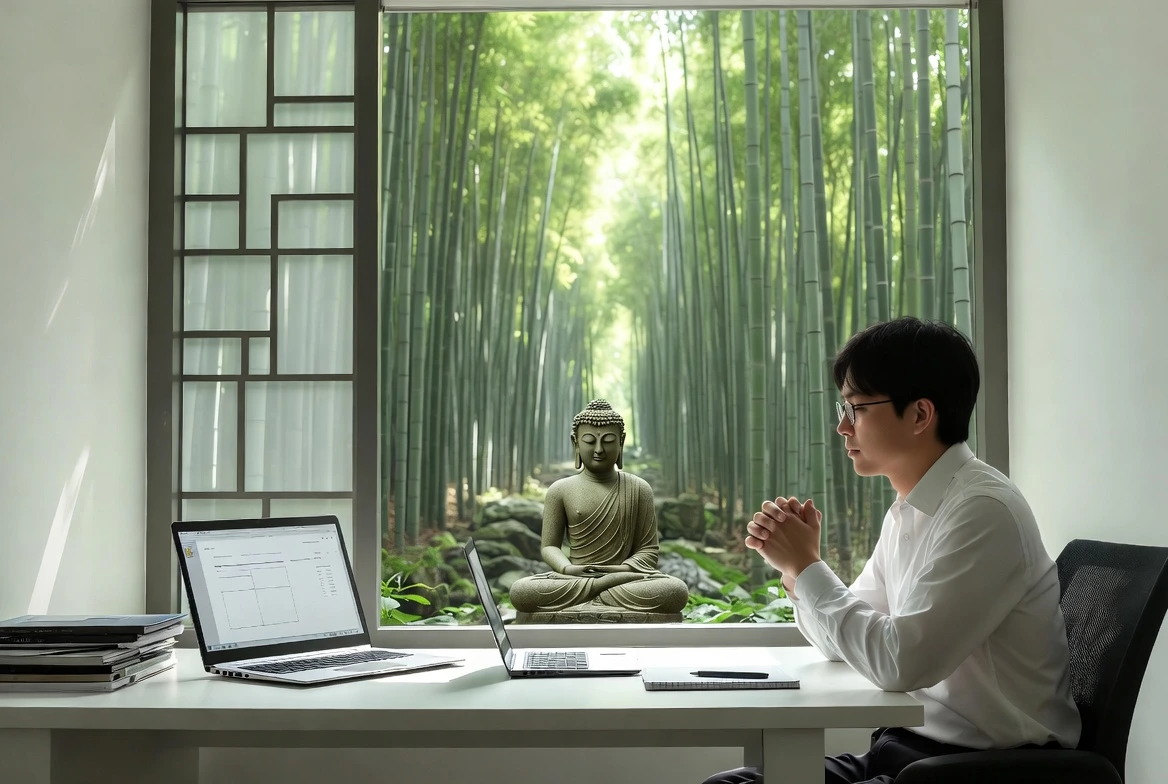
Do What Matters, Not What Shouts: Zen Mindfulness, Deep Work, and Why Your Deadline Management System Needs Both
The average knowledge worker is interrupted every two minutes. Minds wander for nearly half of all waking hours. Most productivity tools respond by adding more to your plate. The better question is whether the problem was ever about doing more in the first place.
By Matt, Duetiful April 2026 10 min read
There is a teaching in Zen Buddhism called ichigyo zammai, or one-practice concentration. When you sit, just sit. When you eat, just eat. When you work, just work. Shunryu Suzuki, the 20th-century Zen master who founded the San Francisco Zen Center, put it this way: when we are fully present in doing one activity, we express our true nature.
This sounds like something you'd read on a tea bag. It also sounds irrelevant to anyone running a law firm with 47 regulatory filings due this quarter, or a migration practice with overlapping visa deadlines across three time zones. How does "just sit" help when your to-do list is on fire?
But the core problem Zen addresses, the confusion between activity and accomplishment, the habit of reacting to whatever screams loudest rather than what actually matters, is the same problem killing productivity across professional services right now. And the structural fix it points toward is more concrete than you might think.
The Attention Crisis Hiding Inside Professional Services
Microsoft's 2025 Work Trend Index found that knowledge workers now experience interruptions roughly every two minutes during core working hours. Asana's research puts 60% of knowledge work time in the "work about work" category: searching for information, switching between apps, sitting in status meetings, chasing down decisions. That leaves 40% for the substantive work people were hired to do.
In professional services, this is not just inefficiency. It is risk. A missed filing date is a potential malpractice claim. A forgotten visa deadline is a client's future derailed. The pressure to keep every obligation visible at all times creates a specific paradox: the more you try to hold in your head, the less cognitive capacity remains to do any of it properly.
The Wandering Mind
Research by Killingsworth and Gilbert at Harvard (published in Science, 2010) found that minds wander from the task at hand approximately 47% of the time. Nearly half of all waking hours spent thinking about something other than what is directly in front of you. For professionals handling time-sensitive obligations with regulatory consequences, that cognitive drift is a compliance risk, not just a productivity leak.
The response from the productivity industry has been predictable: more tools, more notifications, more dashboards. Cal Newport, the Georgetown computer science professor whose research on deep focus reshaped how we think about knowledge work, identified a different structural problem. It is not that professionals lack discipline. It is that the systems they work inside are designed to fragment attention by default.
What Zen Actually Teaches (And Why It Has Nothing to Do with Candles)
Zen Buddhism's Western image (incense, rock gardens, monks sitting in silence) hides what is actually a rigorously practical philosophy about the relationship between attention and action. Strip away the aesthetics and four principles emerge that map directly onto the challenges facing professional services teams trying to manage deadlines without losing their minds.
Principle 1: Not Everything Deserves Equal Attention
Zen teaches non-attachment: the recognition that our habit of treating all stimuli as equally urgent is itself a source of suffering and poor outcomes. In a professional context, this translates directly. Most deadline management failures do not come from neglecting work. They come from treating all work as if it carries the same weight. When everything is urgent, nothing is.
Principle 2: Single-Tasking Outperforms Multitasking. Every Time.
Ichigyo zammai (one-practice concentration) is Zen's answer to the modern multitasking delusion. Neuroscience has since validated what monks understood centuries ago: every time you shift your attention, a cognitive "residue" lingers from the previous task and reduces your capacity on the next one. Doing one thing completely outperforms doing four things partially. The research on this is not ambiguous.
Principle 3: Clarity Comes from Subtraction
Zen aesthetics favour emptiness over ornamentation. The empty space in a painting matters as much as the ink. Applied to workflow design, removing noise (unnecessary notifications, ambiguous task lists, mixed-priority queues) creates more value than adding features. A clean environment, whether mental or digital, enables clear action. Most deadline management software does the opposite: it adds complexity and calls it capability.
Principle 4: Process Over Panic
Zen places emphasis on right action in the present moment, not on anxiety about future outcomes. This is not passivity. It is the opposite. When you trust that the system holding your obligations is reliable, your mind is free to execute with full presence rather than splitting cognitive resources between doing the work and worrying about what you have forgotten.
• • •
Deep Work and the Zen of Structural Separation
Cal Newport defines deep work as professional activities performed in a state of distraction-free concentration that push cognitive capabilities to their limit. That definition converges with Zen's emphasis on single-pointed awareness in ways that are worth examining closely. Both frameworks identify the same enemy: the shallow, reactive, urgent-but-unimportant activity that expands to fill every available moment if you let it.
Newport observed that knowledge workers default to what he calls the "Principle of Least Resistance." Without clear systems, people do whatever is easiest in the moment. Firing off a quick email feels productive. Checking Slack every three minutes creates a sense of responsiveness. But these micro-actions carry a cost that most professionals dramatically underestimate.
Attention Residue
Research by Sophie Leroy (business professor, published in Organizational Behavior and Human Decision Processes) demonstrates that switching your attention, even for 20 seconds to glance at your inbox, leaves a cognitive trace that degrades performance on the primary task for a sustained period afterward. What feels like a harmless "quick check" is, neurologically, self-sabotage. This is the mechanism behind the cognitive load problem that makes deadline tracking in professional services so prone to failure.
Newport's solution: schedule protected blocks of deep, focused work and structurally separate them from the reactive, logistical work that needs to happen but does not need your best thinking. Do not mix the two. Do not let shallow work bleed into deep work time.
Zen's solution, arrived at centuries earlier: when you do something, just do that.
The convergence is not a coincidence. Both frameworks recognise a truth that most task management tools ignore: urgency and importance are fundamentally different categories of work, and mixing them in a single stream degrades your ability to serve either one.
Why Most Deadline Management Tools Make the Problem Worse
Open your typical task management app (Notion, Todoist, Asana, Monday) and everything lives in one flat list. A regulatory filing due tomorrow sits next to a strategic planning document next to a request to update your team bio. They might have different colour-coded labels. But structurally, they compete for the same cognitive space.
This design reflects a common assumption: that the role of a productivity tool is to organise your tasks. That assumption is wrong. Or at least insufficient. Organising tasks does not address the deeper problem, which is that the structure of how work is presented shapes how your brain processes it.
The Busyness Proxy
Newport identified what he calls the "metric black hole" in knowledge work: because it is hard to measure the true impact of deep, focused work, organisations default to visible busyness as a proxy for productivity. A packed calendar and a flooded inbox look productive. They are often indicators of the opposite. In professional services firms, this dynamic is compounded by billable hour cultures that reward volume of activity over quality of output.
When everything competes equally for your attention, the loudest thing wins. Deadlines with imminent consequences naturally generate urgency. Meaningful but non-urgent work (developing a client strategy, building team capability, improving internal processes) gets quietly deferred. Week after week, the important is sacrificed to the urgent, until one day the important becomes urgent too and arrives as a crisis.
Zen has a phrase for this pattern: the "monkey mind." The restless, reactive, anxiety-driven mode of consciousness that leaps from branch to branch without settling. The entire discipline of zazen (sitting meditation) exists to train the mind out of this loop. But you do not need a meditation cushion. You need a system that does not feed the monkey.
Separating Urgency from Importance: The Structural Fix
The practical application of Zen mindfulness to professional productivity is not about breathing exercises between meetings (though those do not hurt). It is about structural design. Building systems that enforce the separation between time-sensitive obligations and attention-worthy deep work, rather than relying on individual willpower to maintain that boundary. Support, not surveillance. Structure, not stress.
Two Lanes, Not One
Professional work naturally divides into two distinct categories:
Time-sensitive obligations (regulatory filings, court dates, visa deadlines, tax lodgements) must happen at a specific time. They carry external consequences if missed. They need reliable deadline tracking, escalating reminders, and team-wide visibility. But they do not necessarily require your deepest cognitive engagement at the moment they are due.
Deep work (drafting a complex brief, analysing a client's financial position, designing a compliance strategy) requires sustained, uninterrupted focus. It creates the highest value. But it is almost never urgent in the moment, and it is the first thing sacrificed when urgency hijacks attention.
| Single-Stream Approach | Separated-Lane Approach | |
|---|---|---|
| Deadline management | Mixed into the general task list | Held in a dedicated, fail-safe system |
| Daily priorities | Whatever is most urgent or most recent | What is most important right now |
| Deep work time | Filled by shallow tasks and interruptions | Protected by structural separation |
| Cognitive load | High: must remember everything | Low: system holds obligations safely |
| Error risk | Increases as workload grows | Contained by backstop system for missed deadlines |
| Attention mode | Monkey mind: reactive, scattered | Ichigyo zammai: present, focused |
When time-sensitive obligations live in their own dedicated structure, tracked, escalated, and backed up through multiple layers, they no longer need to occupy mental space during deep work. The background anxiety of "what have I forgotten?" dissolves because the system is holding it. That psychological safety is what makes genuine focus possible.
From Zen Principle to Daily Practice in Professional Services
Applying these ideas concretely means building five habits into how your team works:
1. Externalise your obligations ruthlessly
The Zen monk does not carry tomorrow's meals in his head while cooking today's. Every time-sensitive commitment (every filing date, renewal deadline, client meeting, regulatory milestone) should be captured in a system with multi-stage reminders and team-level visibility. If it lives in someone's memory, it is not safe. The point is not to track it more obsessively. It is to track it once, reliably, so your mind can release it.
2. Protect deep work structurally, not aspirationally
A recurring calendar block labelled "focus time" that gets overridden every week is not a deep work practice. Structural protection means your time-sensitive obligations do not automatically consume your focus blocks. It means your team knows when colleagues are in deep work mode. It means notifications from the deadline system do not bleed into concentrated work, because the system is trusted to escalate only when intervention is genuinely needed.
3. Reduce what is visible to what is actionable now
A Zen monastery is sparse by design. Not because monks have nothing to do, but because visual and mental clutter impedes clear action. When your dashboard shows 47 tasks across eight clients, you are not informed. You are overwhelmed. Show the one or two things that need attention in this moment. Hold the rest safely out of sight. This is what cognitive load-aware deadline tracking actually means in practice.
4. Build a backstop system into the architecture
Zen's emphasis on impermanence, the recognition that conditions change, attention lapses, and people are fallible, is not pessimism. It is realism. A system that depends on a single person remembering a single deadline is fragile by design. A four-layer safety net (personal reminders at L1, team visibility and nudges at L2, peer backstop escalation at L3, and guardian/partner override at L4) is not about distrust. It is the same compassionate acknowledgement that Zen brings to human limitation: we forget, we get sick, we get overwhelmed, and good systems account for that without punishing anyone.
5. Focus on the action, not the anxiety about the result
The typical workflow under pressure: deadline approaches, stress spikes, work is rushed, output suffers, anxiety about the next deadline begins immediately. The mindful workflow: deadlines are tracked safely by the system, work is scheduled with intention, execution happens without urgency bleeding into it. The quality of the output improves because the quality of the attention improved first. This is what non-punitive accountability in professional services actually looks like.
Most tools organise your tasks. The better question is whether anything is organising your attention.
Why This Is Not Just Personal Productivity
It is tempting to frame mindfulness as an individual responsibility. Download a meditation app, do some deep breathing, be more disciplined. But the research consistently shows that individual effort cannot overcome structural dysfunction. When 82% of workers report experiencing burnout, and only 21% of employees globally describe themselves as engaged at work (Gallup, 2024), the problem is not a shortage of willpower. It is a system design failure.
A 2025 meta-analysis of mindfulness-based programmes published in Stress and Health (Vainre et al.) found that the evidence for mindfulness improving task performance was clearest when the programmes were embedded in the structure of how work was done, not offered as a standalone wellness perk. The meditation room next to the office kitchen is a nice gesture. It does not fix the inbox that generates the stress.
The Engagement Gap
Gallup estimates that global disengagement costs $438 billion in lost productivity annually. But boosting engagement could add an estimated $9 to $10 trillion to global GDP. The gap between where organisations are and where they could be is not about technology or talent. It is about attention: whether people can bring their full cognitive capacity to the work that actually matters.
For professional services firms, this has direct implications. When your team is cognitively overloaded with deadline anxiety, context switching, and coordination overhead, the quality of their substantive work declines. Client outcomes suffer. Error rates rise. And the busier people feel, the less likely they are to flag that something is falling through the cracks, because flagging it requires the very bandwidth that has already been consumed.
The Zen-informed alternative is not about slowing down or doing less. It is about creating the conditions under which people can do their best work on the things that matter most, because the things that are time-sensitive are handled by a system they trust completely. Visibility without surveillance. Accountability without punishment. That is what separating urgency from importance looks like at an organisational level.
Clarity Over Chaos
Suzuki wrote that Zen is not some kind of excitement, but concentration on our usual everyday routine. The path to excellence runs through presence, not through panic.
For professional services firms, where the cost of distraction is measured in compliance breaches, lost clients, and professional liability, this principle has measurable consequences. The firms that will thrive are those that stop treating attention as an afterthought and start treating it as infrastructure: something that can be designed, protected, and systematically supported.
Everything in one list, emails dictating priorities, constant context switching, deep work perpetually postponed. That is the old model. The alternative: time-sensitive obligations held safely in their own structure with a four-layer backstop system, deep work protected by design, less reactive decision-making, and consistent progress on the work that actually moves the needle for clients.
Separate urgency from importance. Do what matters, not what shouts.
Organise Your Attention, Not Just Your Tasks
Duetiful separates time-sensitive obligations from meaningful work, so your team can focus on what matters with nothing slipping through.
- 14-day free trial
- Industry presets for legal, tax, visa & compliance
- Four-layer backstop system (L1 through L4)
- Set up in under 5 minutes
About the Author: Matt is the founder of Duetiful, an AI-powered deadline management platform built for professional services firms: law practices, accounting firms, migration agents, and compliance teams. He is a registered migration agent and non-practising Australian lawyer who has operated professional services businesses since 2007. Duetiful does not organise tasks. It protects attention.
Sources & Further Reading
- Microsoft, 2025 Work Trend Index Annual Report (2025)
- Asana, State of Work Innovation (2024)
- Gallup, State of the Global Workplace (2024)
- Vainre, M. et al., "Mindfulness-Based Programmes for Work Performance: A Systematic Review and Meta-Analysis of Randomised Controlled Trials," Stress and Health (2025)
- Leroy, S., "Why Is It So Hard to Do My Work? The Challenge of Attention Residue When Switching Between Work Tasks," Organizational Behavior and Human Decision Processes (2009)
- Newport, C., Deep Work: Rules for Focused Success in a Distracted World (Grand Central Publishing, 2016)
- Suzuki, S., Zen Mind, Beginner's Mind (Weatherhill, 1970)
- Killingsworth, M.A. & Gilbert, D.T., "A Wandering Mind Is an Unhappy Mind," Science 330(6006), 932 (2010)
- Miro, 2025 Momentum at Work Report (2025)
- ActivTrak, State of the Workplace 2025 (2025)
Comments