
The Biological Corporation: What Dorsey Gets Right About Hierarchy, What He Misses About People
Jack Dorsey and Roelof Botha want to replace middle management with AI. Their diagnosis is sharp. Their prescription is incomplete. Here is what the "Intelligence-Led Company" overlooks about how professional services firms actually work, and why the real opportunity is not replacing the hierarchy but redesigning the support system around the people who remain.
The Argument: Two Thousand Years of Human Routing
On March 31, 2026, Block CEO Jack Dorsey and Sequoia Capital managing partner Roelof Botha published an essay titled "From Hierarchy to Intelligence." The core thesis is disarmingly simple: corporate hierarchy has always been an information routing protocol. From the Roman contubernium to the Prussian General Staff to Daniel McCallum's railroad org chart in the 1850s, layers of management exist because one human can only effectively coordinate three to eight others. When an organisation grows beyond that threshold, you add a layer. Each layer adds latency, distortion, and politics.
Dorsey and Botha argue that AI can now perform the coordination functions that justified those layers. At Block, which cut 40% of its workforce in February 2026, the pair are building what they call a "company world model": an AI system that ingests every decision, code commit, design plan, and workflow artifact to provide real-time operational context to every employee. The hierarchy carried that context before. The model carries it now.
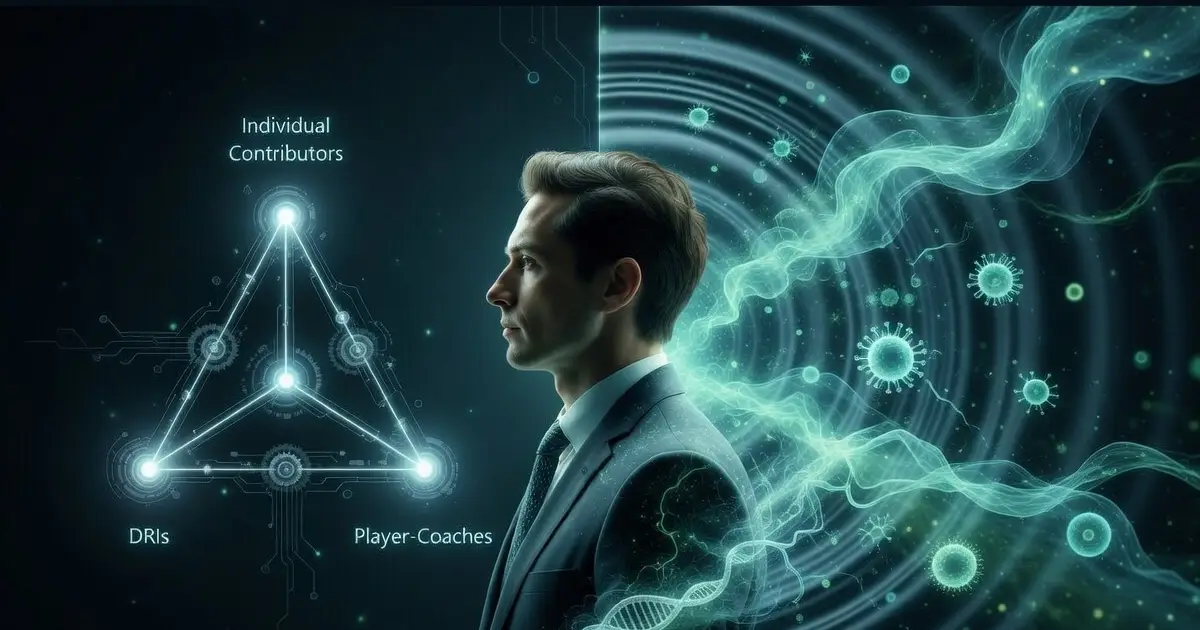
In place of management tiers, Block proposes three roles: Individual Contributors (deep specialists who build), Directly Responsible Individuals (autonomous owners of specific cross-cutting problems on 90-day cycles), and Player-Coaches (mentors who still do the technical work). There is, they write, "no need for a permanent middle management layer."
The Core Proposition
If the hierarchy exists to route information, and AI routes information better, the hierarchy becomes overhead. Replace the routing layer, not the people at the edges.
It is a compelling argument. It is also, in places, a dangerous one. Not because it is wrong about the problem, but because it is incomplete about the people.
What Dorsey Gets Right
The historical analysis is genuinely useful. Most writing about organisational design starts with the Industrial Revolution and treats hierarchy as a natural fact rather than an engineered solution. By tracing the lineage from Rome through Prussia to the American railroads, Dorsey and Botha make the structural logic explicit: hierarchy was the best available technology for coordinating humans at scale when information moved slowly. It was never the optimal design. It was the only feasible one.
They are also correct that most companies deploying AI today are treating it as a productivity enhancer within existing structures, giving everyone a copilot, making the same hierarchy run slightly faster. That is an incremental play. The more interesting question is whether AI can replace the coordination function itself, not the people, but the routing mechanism between them.
And their insight about "artifacts" is underrated. In a remote-first company where every decision and discussion is already recorded, the raw material for a machine-readable operational picture already exists. The information that a middle manager would aggregate in their head, synthesise in a status meeting, and relay up the chain is sitting in Slack threads, Jira tickets, and Git commits. AI does not need to invent that context. It just needs to surface it.
Where the Thesis Holds
For companies with digitally native workflows, the "manager as information router" function is genuinely automatable. The question is what else managers were doing that the model does not account for.
The Biological Metaphor: Where It Helps, Where It Breaks
Reading Dorsey and Botha's essay, the metaphor that kept surfacing was biological. If the "Intelligence Layer" is the central nervous system, continuously monitoring the company's operational signals and distributing context across the organism, then the roles they describe map neatly onto cellular functions.
Individual Contributors are specialised tissue: muscle cells, bone cells, neurons. They focus on growth and repair. They do not route signals. They build.
DRIs are T-cells: autonomous hunters that sense a threat (a customer problem, a market shift, a systemic risk) and move toward it without waiting for instructions from the brain. They carry the antigens (skills) and the authority to act immediately.
Player-Coaches are the endocrine system: hormones circulating through the organism, regulating energy, providing growth factors (mentorship), and signalling urgency. They do not tell every cell what to do. They maintain the conditions for high performance.
This framing reveals the model's greatest strength: fluidity. By removing the "human routers," intelligence is distributed at the edge. A DRI does not wait for a signal to travel up to the CEO and back down again. They act. A large corporation can, in theory, operate with the responsiveness of a small startup.
But it also reveals the model's structural vulnerability.
The Lone T-Cell Problem
In biology, T-cells are autonomous, but they are never alone. They operate within a massive support infrastructure: B-cells that create long-term memory, helper T-cells that amplify the response, cytokines that signal for reinforcement. A single T-cell that exhausts itself fighting an infection without triggering a systemic response is not heroic. It is a design failure.
🚩 The Accountability Trap
In Dorsey's model, the DRI is the single point of accountability for a cross-cutting problem. If they burn out, misjudge the problem, or simply miss a signal, that "infection" spreads unchecked. There is no backstop. Individual accountability without collective resilience is a burnout factory with a single point of failure.
The essay describes DRIs as owning specific problems for 90-day cycles with "full authority to pull resources" from across the company. That sounds empowering. In practice, it means one person carries the cognitive load of diagnosis, coordination, and execution across multiple teams, without the support layer that a manager or team lead would traditionally provide.
The biological immune system solved this problem through quorum sensing: cells detect when they are overwhelmed and signal for a collective response. The organism does not wait for the T-cell to ask for help. The system detects the overload and automatically re-routes support. Dorsey's model, as described, has no equivalent mechanism. The intelligence layer monitors operations, but it does not monitor the humans.
Global Intelligence Is Not Global Understanding
The essay's second major gap is epistemological. Dorsey and Botha assume that providing the same operational data to everyone produces a shared understanding of reality. It does not.
Data is not information until it is processed through a human lens, and every lens is ground differently by experience, expertise, and professional context. A compliance flag in the company world model means one thing to a 25-year veteran lawyer and something entirely different to a junior full-stack engineer. The lawyer sees cascading regulatory risk. The engineer sees a friction point to be optimised away. The AI provides the same signal. The recipients "grok" it in fundamentally different ways.
The Semantic Gap
In neurobiology, the thalamus does not relay every sensation to the cortex. It filters, suppresses, and highlights based on what the organism is currently doing. An intelligence layer that broadcasts operational data without translating it for the receiver is not providing intelligence. It is providing documentation.
Traditional middle managers, for all their "routing" inefficiency, served a vital translation function. They took strategic direction from leadership and compressed it into actionable context for their specific team. They knew that the finance team needed the compliance flag framed as a cost exposure, while the product team needed it framed as a feature constraint. Removing this translation layer does not eliminate the need for translation. It shifts the burden onto the individual, who now has to interpret raw global intelligence through their own limited frame.
The result is decision fatigue. The DRI is not just deciding how to solve a problem. They are deciding what the problem means, which is a fundamentally different cognitive task that scales with the breadth of data they receive.
The Difference of Concerns
This problem intensifies as you move across different levels of concern within the organisation. A founder's primary concern is survival and strategic direction: is the organism moving toward a cliff? A practitioner's concern is execution and compliance: is this specific deadline met, this filing accurate, this customer retained? A specialist's concern is craft and quality: is this code resilient, this interface intuitive, this logic sound?
| Level | Primary Concern | Intelligence Failure Mode |
|---|---|---|
| Founder / CEO | Survival and strategy | Sees the forest but misses the blight on a single leaf |
| DRI / Practitioner | Execution and compliance | Sees the blight but does not care if the forest is moving in the wrong direction |
| IC / Specialist | Craft and quality | Focuses on molecular beauty, often ignoring biological urgency |
These are not just different priorities. They are different epistemologies. The same data point means different things at each level, and "global intelligence" that treats them as a single audience creates noise rather than clarity. An intelligence layer that cannot bridge the gap between a lawyer's experience and an engineer's expertise produces a company that is functionally multilingual with no translators.
Right Information, Right Person, Right Time
The deeper issue is temporal, not just semantic. Even if the intelligence layer could perfectly translate its signals for each recipient, it still has to deliver the right information at the right point in time.
If a practitioner is told about a regulatory change six months before it is enforceable, the signal occupies mental bandwidth without an actionable outlet. They habituate to it. When the deadline arrives, the "intelligence" has become background noise. Conversely, if the signal arrives too late, it is a post-mortem, not a warning.
The biological equivalent is nociception: pain signalling. You do not need to know the temperature of every surface in your kitchen at all times. You need to know the temperature of the stove at the precise moment your hand approaches it. At that millisecond, the signal is the only thing that matters.
The Just-in-Time Intelligence Principle
An effective intelligence system is not a broadcast. It is a reflex. Information should be latent until the practitioner performs an action that intersects with a risk, at which point the system surfaces the signal contextually, surgically, and silently. The burden should not be on the human to interpret the global state. It should be on the system to distil the global state into a single, timely signal that prevents the mistake before it happens.
What We Do Differently: Expanding Circles of Support
At Duetiful, we build compliance infrastructure for professional services firms: law firms, migration agencies, accounting practices. These are environments where a missed deadline is not a product inconvenience. It is a malpractice claim, a regulatory sanction, or a life-altering consequence for a client. The stakes are high, the regulatory landscape is dense, and the people doing the work are already operating near cognitive capacity.
We agree with Dorsey and Botha that the old hierarchy is too slow. But we do not agree that replacing managers with an omniscient intelligence layer is sufficient. The problem is not just information routing. It is support architecture. Specifically, it is ensuring that the person closest to the work is never left as a single point of failure.
Our model is centrifugal rather than hierarchical. Instead of information travelling up a pyramid and decisions travelling back down, accountability and support expand outward in concentric circles from the person doing the work.
Circle One: The Practitioner
At the centre is the person responsible for the task. In normal conditions, they have full autonomy. The system is quiet. No alerts, no dashboards demanding attention, no ambient noise. They focus on their craft.
Circle Two: Automated Support
As a deadline approaches or a risk condition is detected, the first circle of support activates. This is not a global intelligence broadcast. It is a contextual, targeted signal delivered at the moment of relevance: a reminder surfaced when the practitioner opens the relevant matter, a compliance flag triggered by a specific action. The system augments the practitioner's awareness without demanding their attention when it is not needed.
Circle Three: The Backstop
If the practitioner cannot resolve the issue alone, or if they are unavailable, overloaded, or simply miss the signal, the circle expands to include a designated colleague. This is the Backstop: not a manager, not a supervisor, but a peer who has been automatically assigned awareness of the same deadline. If the primary practitioner has not acted by a defined threshold, the backstop is activated. This is quorum sensing applied to professional services: the system detects that the first responder is overwhelmed and routes support before the failure compounds.
Circle Four: The Firm
The outermost circle is the practice leader or the firm itself. They intervene only in systemic exceptions: cascading failures, novel regulatory situations, or high-stakes decisions that exceed any individual's authority. They are not monitoring every task. They are the outer ring that catches what falls through the inner layers.
Why Circles, Not Layers
In a hierarchy, authority is hoarded at the top and rationed downward. In expanding circles, authority stays with the person closest to the work until the work exceeds their capacity. Support scales automatically. The outer circles are quiet until they are needed. The practitioner is not watched from above. They are buffered from all sides.
Dorsey's Library vs. Duetiful's Reflex
The fundamental difference between the two models comes down to the role of the intelligence system.
| Dimension | Block's Intelligence Layer | Duetiful's Approach |
|---|---|---|
| Delivery mode | Pull: searchable, global, always-on | Push: contextual, targeted, triggered by action |
| Failure assumption | The system provides enough context for the individual to act correctly | The individual will sometimes miss the signal, so the system activates a backstop |
| Accountability model | Individual (the DRI owns the problem) | Collective (expanding circles absorb risk) |
| Cognitive load | High (the individual interprets global state) | Low (the system distils the relevant signal at the relevant moment) |
| Burnout mitigation | Implicit (player-coaches maintain the "vibe") | Structural (workload visibility, backstop activation, escalation thresholds) |
Dorsey's intelligence layer is a library. It is comprehensive, continuously updated, and available to everyone. But a library assumes the reader knows what to look for, when to look, and how to interpret what they find. That is a reasonable assumption for software engineers at a well-capitalised tech company. It is a catastrophic assumption for a sole practitioner at a three-person law firm managing 200 open matters with regulatory deadlines across multiple jurisdictions.
Duetiful's system is a reflex. It does not require the practitioner to query a world model. It monitors the environment and activates when the practitioner's hand approaches the stove. And if the practitioner's hand approaches the stove and they do not pull it back, the system activates someone else to pull it back for them.
What We Can Learn From Dorsey
None of this is to say the essay is wrong. There are three lessons from "From Hierarchy to Intelligence" that every professional services firm should internalise.
Lesson 1: Name What the Hierarchy Actually Does
Most firms have never articulated why their management structure exists. Dorsey forces the question: is your hierarchy routing information, making decisions, developing people, or all three? If the answer is "routing information," that function is automatable today. If the answer is "developing people," no AI replaces that, and your structure should reflect the difference.
Lesson 2: Make Work Machine-Readable
Block's advantage is that its workflows already generate digital artifacts. Most professional services firms still operate in a fog of verbal instructions, unrecorded phone calls, and institutional knowledge that lives in one person's head. Before you can build any intelligence layer, you need the raw material. That means structured workflows, recorded decisions, and explicit status tracking. The firms that digitise their operations now will be positioned to benefit from whatever coordination technology comes next.
Lesson 3: Speed Is the Compound Advantage
Dorsey's framing of speed as a compounding competitive advantage is exactly right. In professional services, speed means meeting deadlines with margin to spare, responding to regulatory changes before they become crises, and serving clients before they have to chase you. Firms that reduce the latency between "something changed" and "we acted on it" will outperform firms that rely on weekly status meetings to discover the same information.
The Organism, Not the Machine
The most important shift in Dorsey's essay is conceptual: treating the company as an organism rather than a machine. Machines have fixed parts. Organisms adapt. That framing is correct.
But the essay stops one step short. An organism does not survive by making every cell autonomous. It survives by ensuring that no cell is ever truly alone. The immune system works because T-cells trigger B-cells, which trigger helper cells, which trigger memory cells. Each cell is individually capable. The organism is collectively resilient.
Professional services firms need the same architecture. Not a hierarchy that routes information slowly through human layers. Not a flat intelligence layer that broadcasts data and hopes every individual can interpret it correctly. Instead, an expanding system of support that keeps the practitioner at the centre, stays quiet when things are working, activates the first circle when risk emerges, activates the second circle when the first responder is overwhelmed, and only escalates to the firm level when the situation genuinely demands it.
That is not a hierarchy. It is not Dorsey's model either. It is something quieter, and it is built for the reality of how professional services firms actually fail: not because the intelligence was unavailable, but because it reached the wrong person, at the wrong time, without a backstop.
Built for How Firms Actually Work
Duetiful brings expanding circles of support to deadline management and compliance, so no practitioner is ever a single point of failure.
- Automated backstops for every critical deadline
- Contextual alerts delivered at the moment of relevance
- Workload visibility that prevents burnout before it starts
- No hierarchy required to keep the firm safe
About the Author: Matt is the founder of Duetiful, a compliance infrastructure platform for professional services firms. A non-practising Australian lawyer and Registered Migration Agent with over 20 years of experience across legal practice, migration consultancy, and technology, he builds systems designed around how professionals actually work, not how org charts say they should.
Sources
- Dorsey, J. and Botha, R. (2026). "From Hierarchy to Intelligence." Block, Inc. / Sequoia Capital. Published March 31, 2026. block.xyz
- Fortune (2026). "Jack Dorsey and Roelof Botha think AI can make middle management obsolete." April 2, 2026.
- CoinDesk (2026). "Jack Dorsey says AI should replace the middle manager after Block cuts 4,000 jobs." April 1, 2026.
- Sequoia Capital (2026). "Jack Dorsey: Every Company Can Now Be a Mini-AGI." Podcast transcript. April 3, 2026.
Comments