
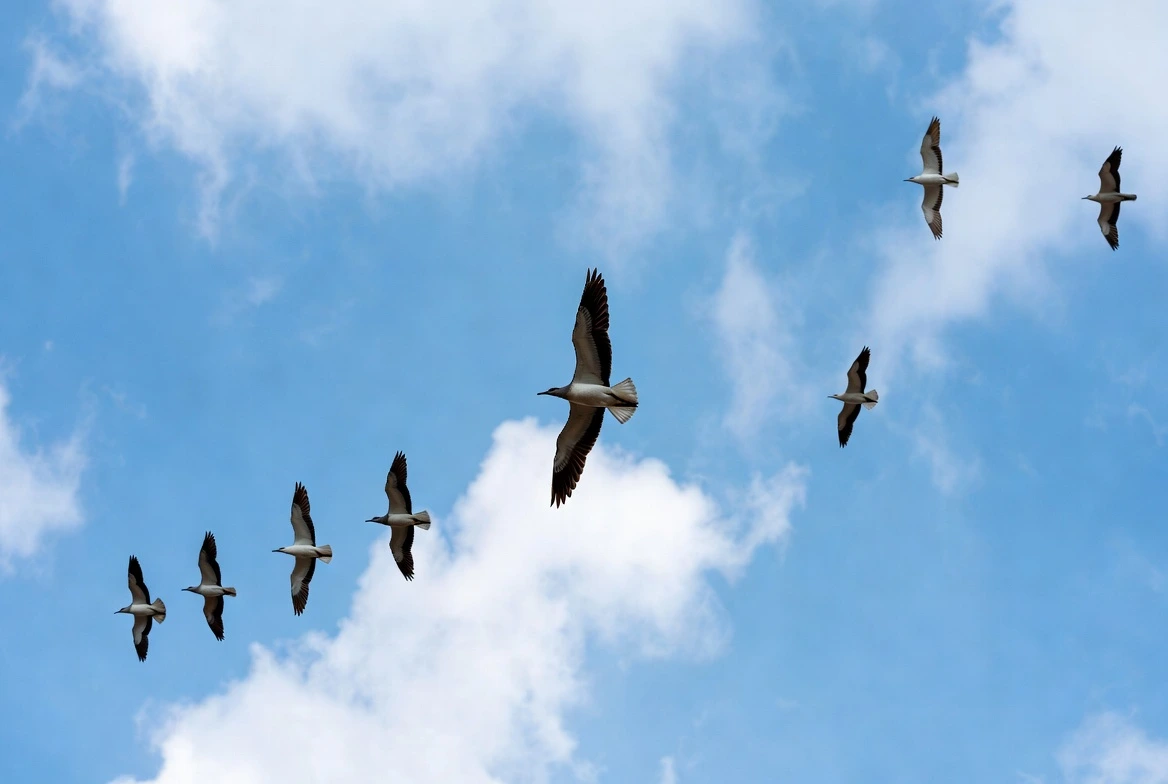
What Birds Teach Us About Productivity: Why Your Firm Needs a Flock, Not a Hero
Every autumn, migratory birds cross entire oceans. Not because any single bird is extraordinary, but because the formation makes the impossible routine. There is a lesson in that for every professional services firm that quietly expects its best people to fly at the front forever.
Watch a skein of geese heading south and you will see one of nature's most elegant productivity systems in action. The V-formation is not decoration. It is a piece of evolved engineering so effective that NASA and Airbus have both tried to copy it. The birds riding behind the leader benefit from upwash (the rising air pushed off the wingtips of the bird ahead) and the energy savings are staggering. Research suggests that a formation of 25 birds can extend their collective range by up to 71% compared with a bird flying alone. Individual studies have measured induced power savings of around 36%, and even modest formations deliver measurable gains.
But the formation only works because of one rule that no bird tries to break: nobody flies at the front forever.
When the lead bird tires, it drops back into the slipstream, and another moves forward. Researchers studying Northern bald ibises fitted birds with data loggers and found that individuals precisely matched the time they spent in the front position with time spent benefiting from another bird's wake. They found no evidence of cheating. No freeloaders, no permanent leaders. The birds cooperated because the alternative was failing to arrive.
The Science of Rotation
An Oxford University study on migrating ibises found that individual birds benefited from the following position 32% of the time, significantly more than expected, and that pair-level checking between birds was sufficient to prevent any single bird from free-riding without leading. The researchers concluded that the extreme risks of long-distance migration drove the evolution of this cooperative behaviour.
The Professional Services Firm Is a Flock Pretending to Be a Solo Act
Now consider the average law firm, accounting practice, or consulting house. The external presentation is polished. A beautifully cut suit, a confident handshake, a mahogany-panelled website. But anyone who has worked inside one of these firms knows the truth: they are ducks on a pond. A three-thousand-dollar suit disguising the fact that most people are paddling like hell underneath the water.
There is nothing wrong with hard work. The problem is how that hard work is distributed and what happens when it isn't sustainable. Professional services firms run on deadlines (court dates, filing dates, compliance windows, regulatory submissions) and the people responsible for those deadlines tend to be the same people, over and over again. The best performers get rewarded with more responsibility. The most reliable team members get given the hardest files. The partner who wins the big client becomes the partner who must service them indefinitely.
In other words, the lead bird stays at the front. And nobody rotates.
The Numbers Are Alarming
Eagle Hill Consulting's 2025 Workforce Burnout Survey found that 55% of U.S. workers are experiencing burnout, with burned-out employees nearly three times more likely to say they plan to leave in the coming year. Professional services firms report burnout rates roughly 22% higher than lower-stress sectors. This is not an abstract problem. It is a retention and performance crisis.
Why the Hero Model Breaks
The hero model, where one exceptional individual carries the critical load, feels intuitive. It feels meritocratic. It even feels flattering to the hero. But it violates the first principle of formation flight: no organism can sustain the energy cost of leading indefinitely, regardless of how strong it is.
In geese, the birds at both the apex and the very tail of the formation consume the most energy. The middle positions offer the greatest benefit. This is not laziness. It is physics. Professional services firms have an identical dynamic. The people at the front (the rainmakers, the lead partners, the senior associates running the biggest matters) and the people at the back (the new hires who haven't yet learned to benefit from institutional knowledge) burn the most energy. The people in the middle, experienced, supported, working within well-structured teams, are the ones who can sustain the pace.
Yet most firms engineer their structures to do the opposite. They load the front position with more responsibility, they strip the middle of autonomy, and they leave the back to figure things out alone. Then they express surprise when their best people crash.
The Formation Principle
Sustainable productivity is not about how fast the fastest individual can fly. It is about how the formation distributes effort so that every member can sustain the journey. A firm where three partners carry 80% of the deadline risk is not high-performing. It is fragile.
Ducks on a Pond: The Hidden Cost of Looking Calm
Every professional services firm has a public face and a private reality. The public face is composed, authoritative, expensive. The private reality is scrambling. Late-night emails, frantic searches for documents, sticky notes on monitors serving as the last line of defence against a missed filing date.
This is the duck-on-a-pond problem. From above the surface, everything looks serene. Below it, the paddling is frantic, exhausting, and invisible to clients. Firms tolerate this because the surface is all the client sees, and because there is a deeply held belief in professional services that suffering is the price of competence.
But suffering is not a business strategy. It is a risk factor. When the paddling gets too hard, the duck does not simply paddle faster. It drowns. And in a firm context, drowning looks like a missed limitation date, a forgotten regulatory filing, a compliance breach that shows up in an audit six months later. The 55% of workers currently experiencing burnout are not just unhappy. They are operating at reduced capacity, making more errors, and increasingly likely to leave.
🚩 The Silent Risk
When a lead bird in formation drops back, the flock adapts instantly. When a key person in a professional services firm burns out or leaves, the consequences can cascade for months. Lost institutional knowledge, orphaned client relationships, deadlines that nobody realises exist until they have passed. The firms that look calmest on the surface are often the ones most vulnerable underneath.
What Geese Know That Partners Don't
Migratory birds have evolved several behaviours that professional services firms would benefit from copying. None of them involve working harder.
1. Rotation Is Not Weakness. It Is Strategy
When the lead goose drops back, it is not demoted. It is recovering so that it can lead again later. In a firm, this means building systems where senior practitioners can step out of the lead position on a matter without the matter collapsing. It means having a second person on every critical deadline. Not as a luxury, but as infrastructure.
2. The Formation Creates the Range
A single goose cannot cross an ocean. A formation of twenty-five can fly 71% further than any individual member. The takeaway is not motivational. It is structural. The question is not "how do we get our best people to work harder?" The question is "how do we arrange our team so that average individual effort produces extraordinary collective range?"
3. Position Matters More Than Talent
In formation flight, a mediocre bird in the right position outperforms a strong bird in a bad position. The same is true in firms. A competent associate with clear role definition, proper support, and visibility over deadlines will outperform a brilliant associate who is isolated, overloaded, and working from memory. Structure beats talent when talent has no structure.
4. Honking Is Communication, Not Noise
Birds in formation honk to encourage the lead bird and to signal their own position. This is not social noise. It is operational communication. In firms, the equivalent is not the annual performance review. It is real-time visibility: knowing who is carrying what, who is tiring, and who has capacity to move forward. Most firms have no system for this. They rely on the lead bird to honk when it is already exhausted.
Evidence: Support Changes Everything
Aflac's 2025 WorkForces Report found that employees who feel a genuine sense of belonging experience workplace stress at nearly half the rate of those who do not (30% vs. 56%) and report meaningfully lower burnout (55% vs. 78%). The formation does not just save energy. It changes how hard the journey feels.
Building a Flock: What This Looks Like in Practice
The bird metaphor is useful, but firms need concrete mechanisms. Formation flight works because it is a system, not a sentiment. Here is what the equivalent looks like for a professional services firm.
The backstop system. Every critical deadline has two people attached to it: the lead and a backstop. The backstop is not doing the lead's work. They are aware of the deadline, they know its status, and they are empowered to act if the lead is unavailable. This is the firm-level equivalent of the bird that moves forward when the leader drops back.
Visible workload distribution. You cannot rotate what you cannot see. Firms need real-time visibility over who is carrying what, not in a spreadsheet updated monthly, but in a system that makes current load obvious to team managers. When a partner can see that one associate is carrying thirty active deadlines and another is carrying eight, the rotation becomes a management decision rather than a crisis response.
Earned recovery. The lead goose does not need permission to drop back. It does so because the formation is designed to accommodate rotation. In firms, this means normalising recovery periods after intense sprints: the end of tax season, the close of a major litigation, the completion of a regulatory submission. Not as leave (which carries stigma in many firms) but as a structural reduction in front-position duties.
Escalation paths that work before the crisis. Birds signal continuously. Firms tend to signal only when something has already gone wrong. Building escalation triggers that fire at "this deadline is at risk" rather than "this deadline was missed" is the difference between a formation that adjusts and a formation that crashes.
• • •
The Firm That Flies Together
There is something almost absurd about a species that weighs four kilograms crossing an ocean, yet geese do it every year. They do it not because any individual goose is remarkable, but because the system (the V-formation, the rotation, the communication, the shared aerodynamics) transforms ordinary capability into extraordinary endurance.
Professional services firms are full of talented people. That has never been the problem. The problem is that those firms are structured like solo flights disguised as formations. The three-thousand-dollar suit looks good from the outside. The mahogany website projects authority. But underneath, individuals are paddling alone, and the firms that cannot see the paddling are the ones that lose people to burnout, lose clients to missed deadlines, and lose their competitive edge to firms that figured out how to fly together.
No bird can fly at the front forever. And no employee, no matter how brilliant, how committed, or how well-compensated, can sustain being the permanent lead without eventually falling from the sky. The question for your firm is not whether you have heroes. It is whether you have a formation that can fly without them.
Stop Relying on Heroes. Start Building a Formation.
Duetiful gives every deadline a backstop, every team real-time visibility, and every firm the structure to rotate without risk.
- AI-powered deadline extraction from emails and documents
- Backstop system with every deadline has a second pair of eyes
- Real-time workload visibility across your entire team
- Escalation triggers that fire before deadlines are missed
About Duetiful: Duetiful is an AI-powered deadline management platform built for professional services firms: law practices, accounting firms, migration agencies, and compliance teams. We believe that no single person should ever be the sole line of defence against a missed deadline. Our backstop system ensures that every critical date has a lead and a backup, so your firm flies in formation, not on the wings of a hero.
Sources
- Lissaman & Schollenberger (1970). "Formation flight of birds." Science, 168, 1003–1005.
- Hainsworth, F.R. (1987). "Precision and Dynamics of Positioning by Canada Geese Flying in Formation." Journal of Experimental Biology, 128(1), 445–462.
- Cutts, C.J. & Speakman, J.R. (1994). "Energy savings in formation flight of pink-footed geese." Journal of Experimental Biology, 189(1), 251–261.
- Voelkl, B. et al. (2015). "Matching times of leading and following suggest cooperation through direct reciprocity during V-formation flight in ibis." PNAS. Via Oxford University / ScienceDaily.
- Eagle Hill Consulting (2025). "Workforce Burnout Survey 2025." November 2025.
- Aflac (2025). "15th Annual WorkForces Report." October 2025.
- Meditopia (2025). "Employee Burnout Statistics 2026: Global & Workplace Insights."
Comments